Saharanpur Mosque Demolition: Full Story and Legal Dispute
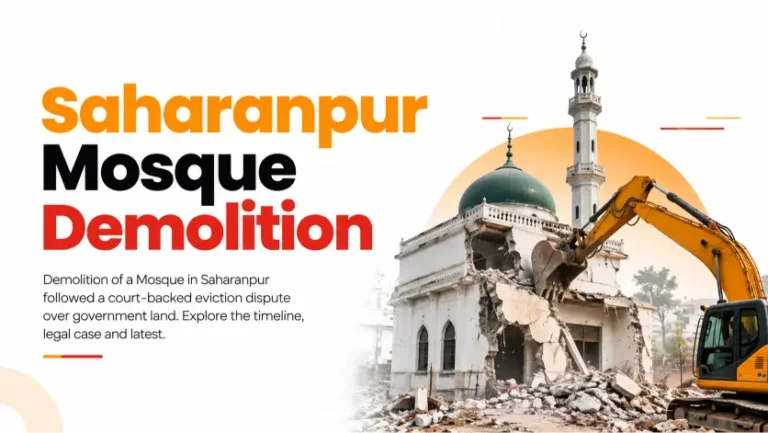
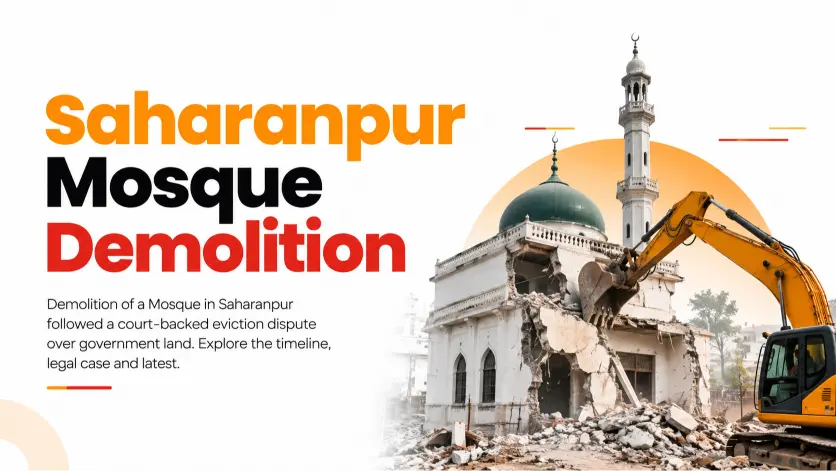
A mosque located inside the Saharanpur Collectorate complex in Uttar Pradesh was demolished on September 5, 2026, following a long-running dispute over whether the structure was legally occupying government land. The demolition came just three days after a district court dismissed an appeal filed by the mosque management against an earlier eviction order.
The action quickly became a national news story because of the mosque’s reported age, the legal dispute over its land status, historical documents cited by the mosque management, and questions surrounding the speed of the demolition after the September 2 court decision.
Here is what happened, what the courts decided, why the mosque was demolished, and why the case has generated wider debate in India.
What Happened to the Saharanpur Mosque?
The mosque stood inside the Saharanpur Collectorate complex in Uttar Pradesh. Authorities said the structure occupied government land without valid authorization and had therefore become subject to eviction proceedings.
According to reporting based on the court proceedings, the disputed structure covered approximately 315 square metres. The City Magistrate had earlier ruled against the mosque management under the Uttar Pradesh Public Premises (Eviction of Unauthorised Occupants) Act, 1972. The order was subsequently challenged before the district court.
On September 2, 2026, the district court dismissed the appeal and upheld the earlier eviction decision. On September 5, the administration carried out the demolition inside the Collectorate premises under heavy security.
The administration described the action as enforcement against an unauthorized structure on government land. The mosque management and its supporters, however, questioned whether an eviction order automatically gave authorities the power to demolish the structure and raised concerns about due process.
Why Was the Mosque Demolished?
The central issue was not simply the religious identity of the building. The legal dispute focused on the status of the land and the authorization of the structure.
Authorities maintained that the mosque had been constructed on government property without lawful authorization. A complaint that helped initiate the proceedings was filed by Vikas Tyagi, who was associated with the Bajrang Dal. The case subsequently moved through the local administrative and judicial process.
The City Magistrate’s July 16, 2026 order held that the structure occupied government land and directed its removal. Reports also state that the order imposed a financial penalty of about ₹6.41 crore on the mosque management in connection with the unauthorized occupation.
The mosque committee challenged the decision, but the district court rejected its appeal on September 2.
The administration then proceeded with the removal on September 5.
Saharanpur Mosque Demolition Timeline
| Date | Development |
|---|---|
| 2025 | A complaint was filed concerning the legality of the mosque inside the Collectorate premises. |
| July 16, 2026 | The City Magistrate ruled that the structure occupied government land and ordered its removal. |
| September 2, 2026 | The district court dismissed the mosque management’s appeal and upheld the earlier eviction decision. |
| September 5, 2026 | Authorities demolished the mosque inside the Saharanpur Collectorate complex. |
| September 9, 2026 | A petition challenging the demolition orders was reported before the Allahabad High Court. |
The timeline is important because the demolition followed only a short period after the district court’s September 2 decision. Indian Express reported that the September 2 order upheld the eviction decision but did not itself expressly state that the mosque should be demolished.
What Was the 1911 Electricity Bill Dispute?
One of the most discussed aspects of the Saharanpur mosque case concerns historical evidence presented by the mosque management.
The management reportedly relied on documents including an electricity bill dated to 1911 to argue that the structure had existed for many decades and predated parts of the present administrative complex.
That evidence became part of a broader dispute over the history and age of the mosque.
The administration questioned the reliability of the historical claim and disputed the implications of the electricity document. Reports published after the demolition described the issue as a significant point of disagreement between the two sides.
The historical age of a religious structure, however, does not by itself settle a modern land-occupation dispute. The central legal question before the local authorities was whether the structure had lawful authorization to occupy the government property.
What Did the Court Decide?
The district court upheld the earlier order issued by the City Magistrate.
According to reports reviewing the judgment, the earlier order was made under the Uttar Pradesh Public Premises (Eviction of Unauthorised Occupants) Act, 1972. The court accepted the administrative position concerning the government’s ownership of the disputed land and rejected the mosque management’s appeal.
There is an important distinction here.
The September 2 judgment upheld the eviction order, but reporting on the judgment indicates that it did not expressly issue a separate order saying that the mosque must be demolished on September 5. The administration’s position was that removal of the structure followed from the earlier eviction order, while the mosque management disputed whether demolition was legally authorized in that manner.
That distinction is now part of the continuing legal debate.
What Did the Administration Say?
Officials defended the action as enforcement of an existing legal decision involving government land.
Authorities said the mosque had been declared unauthorized and that the district court’s dismissal of the appeal cleared the way for implementation of the earlier order.
Security forces were deployed around the Collectorate during the demolition. Reports said the gates of the complex were closed and police, including Provincial Armed Constabulary personnel and the Rapid Action Force, were deployed to maintain order.
The administration also appealed to the public to maintain peace and avoid rumours.
From the government’s perspective, the case was therefore primarily a question of unauthorized occupation of government property, rather than a decision based on the religious identity of the structure.
What Did the Mosque Management and Critics Say?
The mosque management challenged the administrative interpretation and argued that the structure had a long history at the site.
The management also raised concerns about the manner and timing of the demolition. Its representatives argued that the demolition took place very soon after the district court’s decision and questioned whether there was sufficient opportunity to pursue further legal remedies.
A petition was subsequently filed before the Allahabad High Court challenging the orders connected with the demolition. The petition reportedly argues that the City Magistrate and district judge acted without proper jurisdiction or legal authority.
This means that the legal story did not necessarily end with the September 5 demolition.
Why Has the Saharanpur Mosque Demolition Become Politically Controversial?
The demolition has become politically sensitive because it comes against a wider backdrop of disputes over religious structures, land, municipal enforcement and demolitions in Uttar Pradesh.
Supporters of the government’s approach argue that public land cannot be occupied unlawfully and that administrative rules should apply regardless of religious identity.
Critics, however, argue that demolition actions involving Muslim religious structures require particularly careful scrutiny and due process.
The controversy has therefore developed along two competing interpretations.
One focuses on government land and unauthorized construction.
The other focuses on religious freedom, minority rights and the manner in which administrative powers are exercised.
Keeping these positions separate is important because they represent different claims about the same event.
How Does This Fit Into the Wider Debate Over Mosque Demolitions in India?
The Saharanpur case is not occurring in isolation.
In recent years, several mosque and religious-site disputes in India have involved questions of land ownership, road expansion, unauthorized construction, historical claims and the legal status of religious properties.
The wider debate has also been influenced by earlier controversies involving sites such as the Babri Masjid, Gyanvapi Mosque and Shahi Jama Masjid in Sambhal.
However, these cases are legally different from one another and should not automatically be treated as identical.
The Saharanpur dispute specifically centres on the status of a mosque located inside a government administrative complex and the application of public-premises law.
What Does Indian Law Say About Religious Places?
India’s legal framework contains several protections and restrictions concerning religious places.
The Places of Worship (Special Provisions) Act, 1991 seeks to preserve the religious character of places of worship as it existed on August 15, 1947, subject to the Act’s provisions and exceptions. The Supreme Court discussed the purpose and structure of the legislation in its 2019 Ayodhya judgment.
However, the Saharanpur dispute is principally described in current reporting as a government-land and unauthorized-occupation case.
That distinction matters.
A dispute over whether a structure lawfully occupies government property is not automatically the same legal question as a dispute over changing the religious character of a place of worship.
What About Supreme Court Rules on Demolitions?
The wider debate over demolitions in India has also been shaped by Supreme Court proceedings concerning the demolition of structures.
The Supreme Court’s proceedings in In Re: Directions in the Matter of Demolition of Structures have addressed procedural safeguards and the limits of executive power in demolition cases.
For that reason, questions about notice, hearing, appeals and the authority under which a structure is removed can become important when assessing individual demolition disputes.
In the Saharanpur case, these questions are particularly relevant because the mosque management has challenged the legal basis and procedure surrounding the demolition.
Why Is the Case Important?
The Saharanpur mosque demolition has significance beyond the physical removal of one structure.
It raises several broader questions:
- How should government land be protected from unauthorized occupation?
- What legal process should authorities follow before demolishing a structure?
- How should historical documents be assessed in land disputes?
- What remedies remain available after an eviction decision?
- How should religious freedom be balanced with public-land regulations?
- Can an eviction decision automatically justify demolition?
- What role should higher courts play when demolition happens soon after a lower-court decision?
These questions are likely to remain relevant while the legal challenge develops.
What Happens Next?
The next stage of the dispute is likely to focus on the legal challenges surrounding the orders and the manner in which the demolition was carried out.
A petition challenging the demolition-related orders was reported before the Allahabad High Court on September 9, 2026. The petition challenges the July 16 City Magistrate order and the September 2 district-court decision.
Therefore, the Saharanpur mosque story should not be viewed only as a completed demolition. The administrative action has already taken place, but questions surrounding its legal basis and procedure can continue through the courts.
Conclusion
The demolition of a mosque in Saharanpur on September 5, 2026, followed a prolonged dispute over government land, authorization and eviction.
Authorities maintained that the structure was an unauthorized occupation of government property, while the mosque management challenged the decision and raised questions about the structure’s history and the process leading to its demolition.
The September 2 district-court decision was a crucial development because it upheld the earlier eviction order. The demolition followed three days later, creating further debate over the distinction between eviction and demolition and whether all available legal remedies had been adequately respected.
With a challenge subsequently reaching the Allahabad High Court, the legal questions surrounding the Saharanpur Collectorate mosque may continue to develop.
Frequently Asked Questions
Why was the Saharanpur mosque demolished?
Authorities said the mosque occupied government land without lawful authorization and was subject to an eviction order. A district court upheld the earlier decision on September 2, 2026, after which the administration demolished the structure on September 5.
When was the Saharanpur mosque demolished?
The mosque inside the Saharanpur Collectorate complex was demolished on September 5, 2026.
How old was the Saharanpur mosque?
Reports described the mosque as more than a century old, with the mosque management citing historical documents, including an electricity bill dating to 1911, in support of its claim about the site’s history.
What did the court decide about the mosque?
The district court dismissed the mosque management’s appeal on September 2, 2026, and upheld the earlier eviction order concerning the structure’s occupation of government land.
Was the demolition itself challenged?
Yes. A petition was reported before the Allahabad High Court challenging the orders connected with the demolition and arguing that the authorities lacked proper legal authority to take the action.
Is Saharanpur the only recent mosque demolition in India?
No. Other mosque demolition and religious-site disputes have been reported in India in recent years. However, each case has its own facts, land status, court proceedings and legal basis, so they should not automatically be treated as the same type of dispute.